About
A partnership,
not a brand.
This project lives in two places, and it begins in Pucallpa.
In Pucallpa, in the Peruvian Amazon, Demer — Shipibo name Korin Niwe — coordinates the artisans, photographs the work, holds the relationships with the communities, and runs the foundation that protects the designs. In the Netherlands, Steven builds and runs this site, handles the international side, and writes these words.
We are partners. The project belongs to both of us, and through us to the artisans and the foundation we serve. This page is mostly about Demer, because the project begins with him.
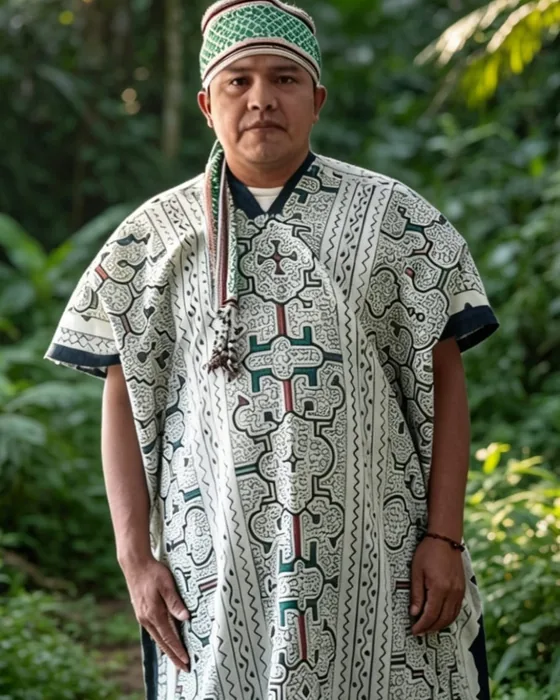
Demer — Korin Niwe
Raised in the
forest.
Demer was born in the native community of Nueva Samaria, in the district of Iparía, region of Ucayali — a tropical community of forests, rivers and cochas, the oxbow lakes of the Amazon. As a child he played football, planted yuca and plantain with his family, and learned from his grandfather how to make arrows and fish the rivers.
It was a very beautiful life, very harmonious, with much love, beside my family, in the middle of nature. Demer
His father was a primary-school teacher, but also a farmer, a fisherman, and a master of medicinal plants — teaching Demer to prepare remedies, to make a canoe, to build a house, and above all not to forget his roots.
His mother was a master artisan, expert in the embroidery and painted cloth of the Shipibo-Konibo tradition. She taught him to paint and to embroider. When he was two years old she placed the kené on his navel and began the dieta with the kené waste plant — the traditional way of receiving the wisdom of the designs.
She explained to me what the meanings were. The kené is everything to me. It is a universe. Demer
Today Demer is studying Economics at the Universidad Tecnológica del Perú, financing his studies through his own work. His aim is to become the first economist of the Shipibo-Konibo people.
Fundación Kene Rao
The first institution
to defend the kené.
Founded by Demer on 8 March 2021 — the first and only institution in Peru working on intellectual property rights for the kené.
Before, the kené was patented without consent, without consultation, without royalties. They stole a lot. We are the first institution that took the initiative to change that. Demer
Education
Intercultural bilingual workshops for children in native communities — so the next generation continues to know the culture, the language, and the designs of the Shipibo-Konibo people.
Intellectual property
Workshops for artisans and artisan associations on copyright, licensing, and how to protect their designs. The foundation drafts contracts and produces guides on author's rights.
Legal counsel
Direct representation of artisans whose rights have been violated, and of artisan associations in their commercial agreements.
Social responsibility
Water tanks for communities drinking contaminated river water. School supplies at the start of each academic year. A Christmas chocolatada in remote communities the state does not reach.
The happiest moment as a foundation is when you give royalties to an artisan and she feels happy. Seeing an artisan smile when she receives her royalties — that is the happiness that drives us. Demer
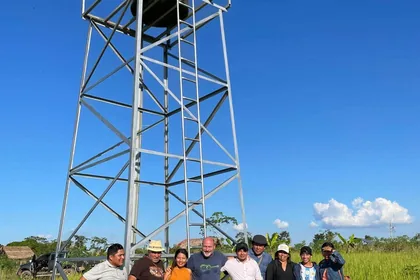
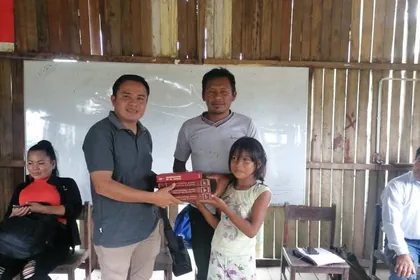
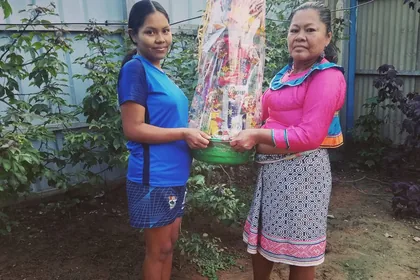
The foundation's board is entirely Shipibo. Its aim over the next five years is to see Shipibo designs legally protected and registered, artisans empowered with just royalties, and the culture transmitted intact to the next generation.
How the partnership works
No middleman
in Pucallpa.
Demer brings the relationships, the cultural authority, the photography on the ground, and the legal protection through the foundation. Steven brings the site, the infrastructure and the European side of the work. The two communicate almost daily, in Spanish and English mixed freely.
What comes back from this work flows along one path: to the artisan by name, to Demer's coordination work in Pucallpa, and to the foundation's community programmes. There are no investors taking a cut, and there is no middleman in Pucallpa.
I want the world to understand that the cloth and the kené are not just a drawing. They are not decoration. They go further. The kené is a story. The kené is our voice and our way of seeing life, drawn in lines. Demer
Stay close
Follow the work.
Stories from Pucallpa, news from the foundation, and first word when new pieces arrive.