The language
What is kené?
It looks, to outside eyes, like pattern. To the people who carry it, it is a map of the world.
Kené is the geometric language of the Shipibo-Konibo people of the Peruvian Amazon. It is painted and embroidered onto cloth, ceramic, jewellery and the body itself.
More than a design, it represents our four worlds — our rivers, our cochas, our fish, our water, our agriculture, our forest. The kené represents that — our harmony, our habitat. Demer
The Shipibo cosmology has four worlds. The kené is how those worlds are written down.
Origin
Not invented.
Received.
The kené is a knowledge that comes from the world beyond, from the spiritual world. And it manifests in the visible world. Demer
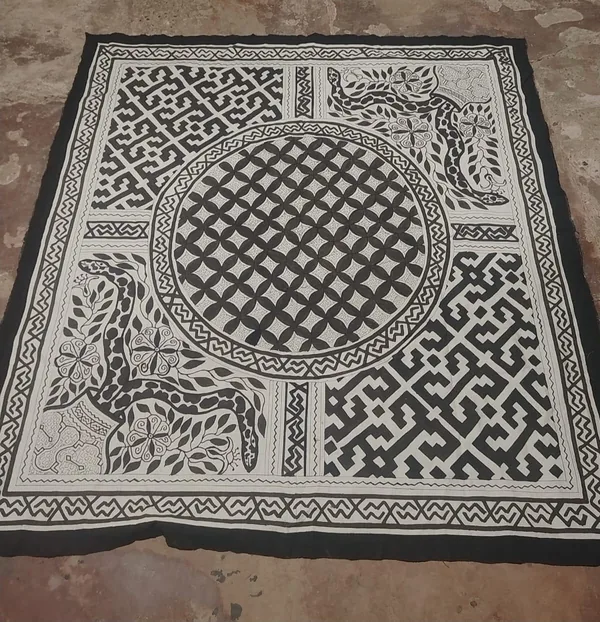
In the Shipibo-Konibo tradition, the great healers and master plant-teachers — the unanibo and the murayabo — entered deep states of connection through ceremonies with master plants. In their visions, in one of the four worlds, they saw the head of the ayacumama, the great anaconda and mother of all serpents in the Amazon, and from her head emerged designs. Many designs. They returned, and they brought those designs into the world we live in.
They also found which plants carry the wisdom of the kené itself — chief among them the piripiri and the kené waste. From that point on, mothers and grandmothers prepared their daughters by placing the kené on the navel or in the eyes, so that the next generation would carry not only the designs but the inner wisdom the designs come from.
The kené waste is not only for the design. The kené is also to have wisdom, to have knowledge, to be intelligent. Demer
This is why kené is not the same as decorative pattern. It is received, not invented; it is carried in the body before it is drawn on the cloth.
The named patterns
Thousands of designs.
Six families.
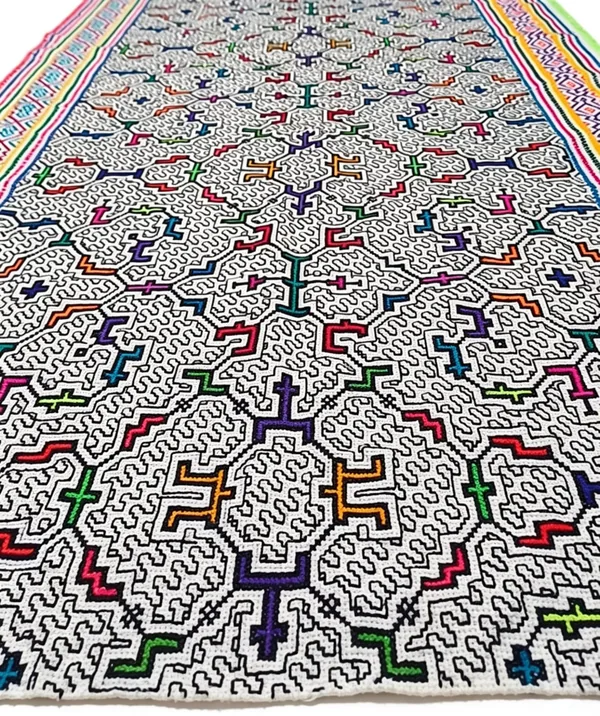
There is no single canonical pattern — a different vision for every artisan, every ceremony, every cloth. But the Shipibo-Konibo recognise distinct families of design.
Shokené
The oldest design. From sho, the Shipibo word for bone — specifically the bones of the fish. The shokené was the first kené of the Shipibo people.
Mayakené
The curves of the river. Curving, circular designs representing rivers, lagoons and the Shipibo habitat. The mayakené comes from the head of the anaconda — the place where the kené was first revealed.
Rununkené
The skin of the great serpent. From the body of the yakumama, the mother anaconda. The plant masters saw, in vision, designs emerging from the skin of the serpent's body, and brought that pattern into the embroidery.
Kurúskené
The cross. This pattern came from contact with the missionaries who arrived in the Amazon. They brought the cross, and the Shipibo took it into their visual language as a kené of geometric cross forms.
Buchikunanakemi
The mirror. A pattern in which two figures face each other — the Shipibo woman and the Shipibo man, mirrored.
Visión
The vision pattern. A design depicting the vine itself, with kené patterns worked within it. Sometimes called flor de vida — the art within the art.
Kené has no gender. Any pattern can be worn or made by anyone. As Demer puts it: there is no separation — a man can wear mayakené, a woman can wear shokené. It depends on taste.
Protection
A path, not
a settled right.
Until now we do not have sacred designs, because they are not yet protected. That is the path. Each artisan, each master, has her own design. We want that in the future no one can touch them. Demer
Designs become protected when they are registered — legally shielded so they cannot be reproduced without consent. That is the great challenge of the foundation, and the reason it exists.
Stay close
Learn to read the lines.
Stories from the artisans, notes on the designs, and first word when new pieces arrive from Pucallpa.